

The school shootings that shaped us
A generation shaped by school shootings and the three students who set out to fix a broken system.

On paper, we really had no right to be dreaming up novel solutions to public safety problems.
We were just three students at Yale. Studying computer science. Working out of a dorm room-turned-office. We didn’t know anyone in the safety sector, let alone a cop, and our understanding of the 911 world we were seeking to impact was… zero.
I’m glad no one calculated the odds of us “making it” back then.
Though I’m not sure that would have deterred us, for one simple reason: Our mission was to build software that saved lives.
And our starting point was school shootings — a subject we knew way too much about.
Dylan Gleicher and I attended the same high school in Westport, Connecticut. In 2018, we were locked down because of an active shooter threat. Six years earlier, a mere 30 miles away in Newtown, 20 children were killed by a gunman at Sandy Hook Elementary.
That same year, 14 students and 3 staff members were killed in Florida at Parkland High School, where Dylan’s cousin worked as a counselor. In the following four months, the US saw another seventeen school shootings.
It’s why we had monthly drills. Closing blinds. Barricading doors. Hiding under desks. Huddling in corners away from windows. That was part of our education. As it was for our fellow cofounder, Prepared’s CEO Michael Chime.
In 2012, the same year as Sandy Hook, his community was affected by a shooting at Chardon High School, Ohio, where three students were killed by an armed teenager.
For us, school shootings were front of mind, not some abstract possibility. And it seemed that everybody knew somebody who had been affected by one.
As a result, our generation thought about safety far more than our parents ever did, and we felt the need to act.
As Michael put it plainly:
“We have to do something in schools.”
Seven simple words. One clear objective.
Even if we had no idea how to go about it.
“This Is Not a Drill.”
On February 27 2018, I was 17 and sick in bed with a virus when the first text messages came through from friends at my high school, Staples. “Active shooter!” one friend texted. “We’re in lockdown!” said another. “This is not a drill!”
This came two weeks after the Parkland shooting. Was this a copy cat?
A Staples student with access to guns had stated he wanted to shoot a teacher. Thankfully, nothing happened, but police later confirmed that “the student did have thoughts of executing a mass shooting at the high school.”
What stayed with me from that day were the emotions: the realization that a school shooting could actually happen in my small town, and the helplessness of not having any ability to change that.
So I was determined to help moving forward, and that motivation would shape a moment in our dorm room at Yale one year later — the day Prepared was founded.
Our startup was born out of the hope that we could make a difference, and motivated by memories we couldn’t forget.
How Hard Can It Be?
In those early days, all we knew how to do was build mobile applications for schools.
I had previously built a sports scheduling app, CTSports, used in 120 high schools in Connecticut. Then, as a sophomore, I teamed up with Dylan to create iStaples, a scheduling app specifically for our high school. Out of 1,800 students, 1,200 used it every day — usage that taught us the power of technology. It made us believe we could build anything.
When it came to figuring out a school shooting app, we thought: How hard could it be?
I live by the figure-it-out-as-you-go rule. My parents weren’t engineers, but I still went into school determined to figure out how to build robotics and learn programming. My attitude has always been ‘Give me a fun problem and I’ll figure it out.’
So when Michael and Dylan asked for my help to build Prepared, I didn’t hesitate.
I saw the problem: communication breakdowns in an emergency. I believed in the mission: build software that saves lives. I was immediately all-in.
Michael was the visionary who could sell anything, Dylan the super-technical genius, and in theory, I was the product/engineering brain, and it was my second week at Yale.
The first thing we did was dive into incident reports from dozens of shootings, and we learned that each one involved communication challenges exacerbated by a central PA system — the only means of issuing an alert.
The whole alert process was what we called “the relay race”:
Student sees a shooter → student finds a teacher → teacher finds a phone → teacher calls main office → office has to answer → someone runs to PA system → lockdown announced over PA system.
In Parkland, this relay race took 3 minutes before the school went into lockdown — with students evacuating due to the fire alarm going off. The shooting itself lasted 6 minutes.
Michael’s idea was simple: Everyone has a phone, so let’s turn that into a panic button, creating a decentralized, faster communication system.
Faster response times = saved lives.
“This Looks Childish.”
Dylan, Michael, and I stayed up all night in our dorm room to build a rudimentary mobile panic button. Within 48 hours, we were ready to show it to a principal Michael had been talking to.
We walked into that meeting anticipating praise or at least some helpful feedback. We received neither. “This looks childish,” he said, point blank. Translated: “Nice idea guys but why are you wasting my time with this?!”
For some people, that harsh response might have wrecked their self-belief. Not us. We thought “Amazing, how can we make it look more professional”?
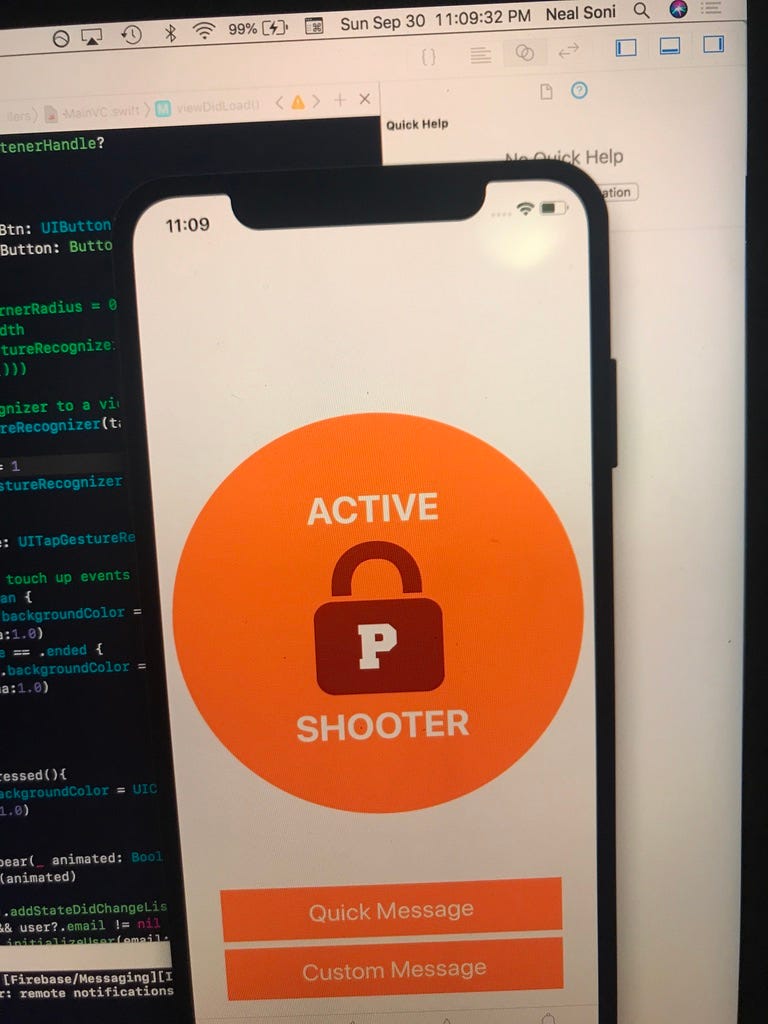
Dylan and I kept burning the midnight oil, doing research and bouncing ideas around while continually finessing the UX in Photoshop (it’s all we knew at the time 😅).
Dylan, Mike, and I took the same classes to reduce our time on homework. And when we weren’t studying, we were in our dorm room focused on Prepared, determined to make the app perfect.
When a suite-mate went abroad to study, we converted his dorm into our first office. A tiny room filled with monitors, programming, and the three of us, surrounded by pizza boxes and mugs. I would regularly get back to my bedroom at 3am, and take naps to survive.
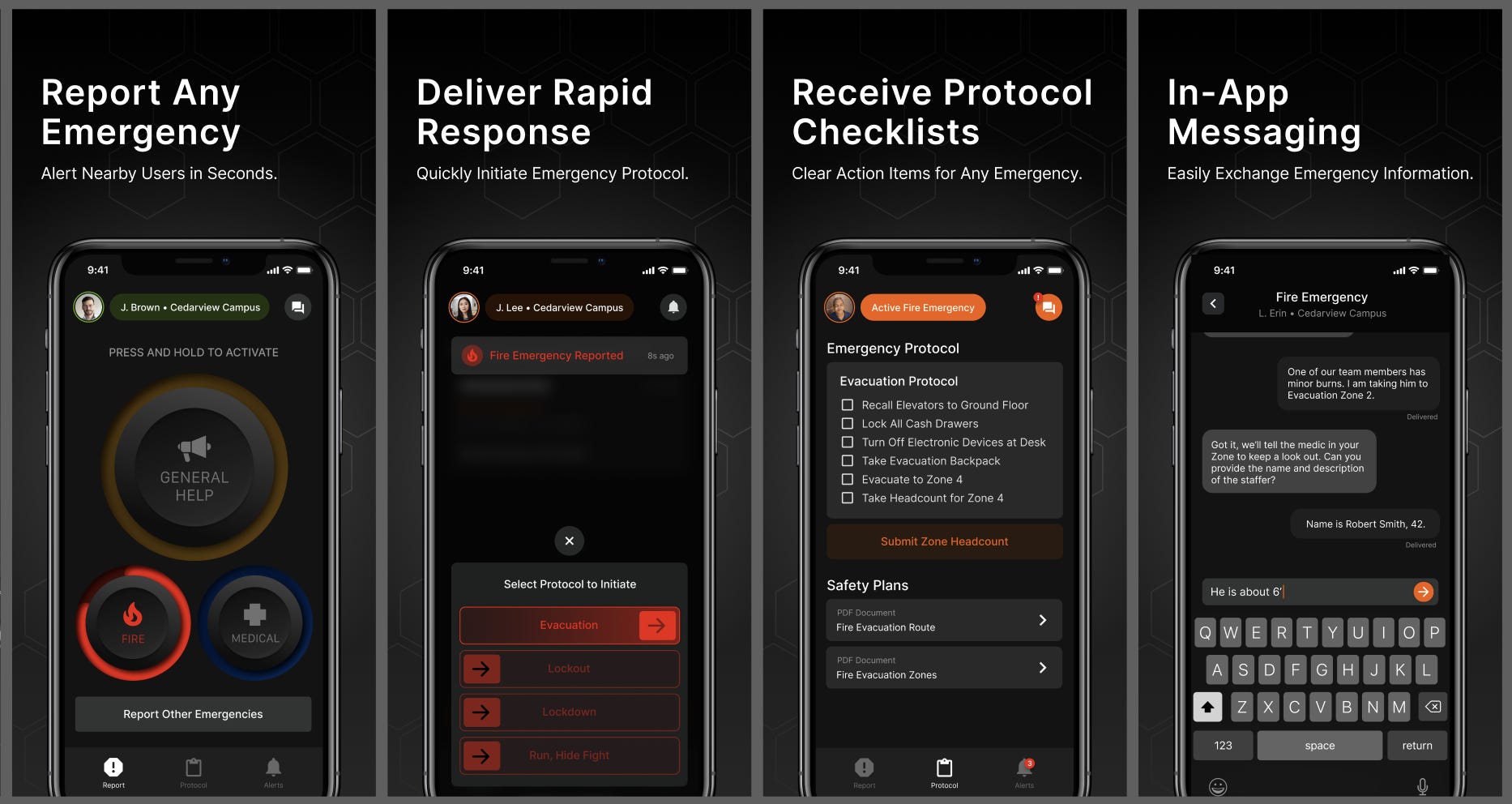
The product was straightforward: In a school shooting, a teacher would press the in-app button to send a critical alert to the phones of teachers and administrators, triggering a lockdown. The app then allowed for a roll call per class, the sharing of locations, and messages between staff.
Eventually, our hard work started to pay off: In February 2019, we signed our first school a few months later in a $24,000 contract for 12 schools in Louisiana. And since we paid ourselves nothing, we were instantly profitable!
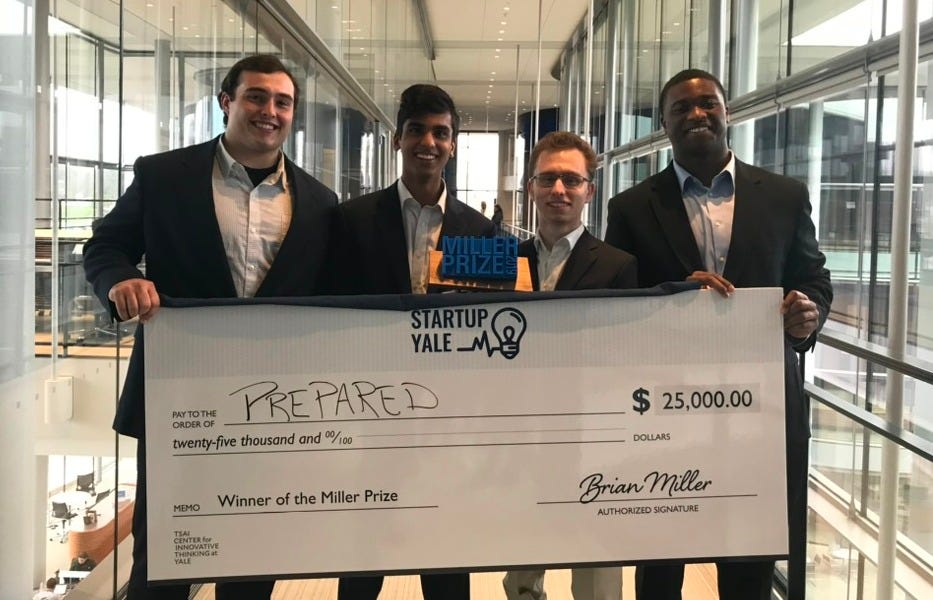
Two months later, we hit another milestone. We secured a $40,000 grant after winning Yale’s Top Tech Startup competition.
Not only that, but we were making waves at a time when Alyssa’s Law, named after a victim of the Parkland shooting, was being passed, mandating silent panic alarm systems in public schools, linked to 911 centers.
Everything seemed to be falling in our favor. But then we had a reality check.
After launching in 44 schools across New Haven Public Schools in September 2021, the limitations of our product became clear.
Whenever we went “live” with a school, something always seemed off. It felt like pulling teeth to get teachers to even download the app. Plus, a teachers union started to throw around what I refer to as FUD (Fear, Uncertainty, and Doubt), posturing about staff using a school-sanctioned apps on personal devices.
In addition, we came to realize that our “solution” may have helped with an internal school response but it did nothing to improve reporting to 911. A big disconnect.
Teachers wanted information collected by our app — GPS data of the panic activation, number of students in a class, everyone’s locations, a suspect’s descriptions, and video from people’s phones — to be conveyed to 911 centers and police in the moment.
In short: No one downloaded it. When it was downloaded, no one ran drills. When drills were run, it didn’t resolve that emergency. So what was the point?
Pivoting Without Losing the Mission
The root problem lay with the archaic systems that the whole emergency system relied on. A panic button was going to be a layer of duct tape covering a gaping hole.
So we kept hackathoning and trying different things to solve the root problems. I knew there had to be a better way.
We created a panic button for hospitals, hotels, and places of worship. We locked down our first hospital chain in 2021.
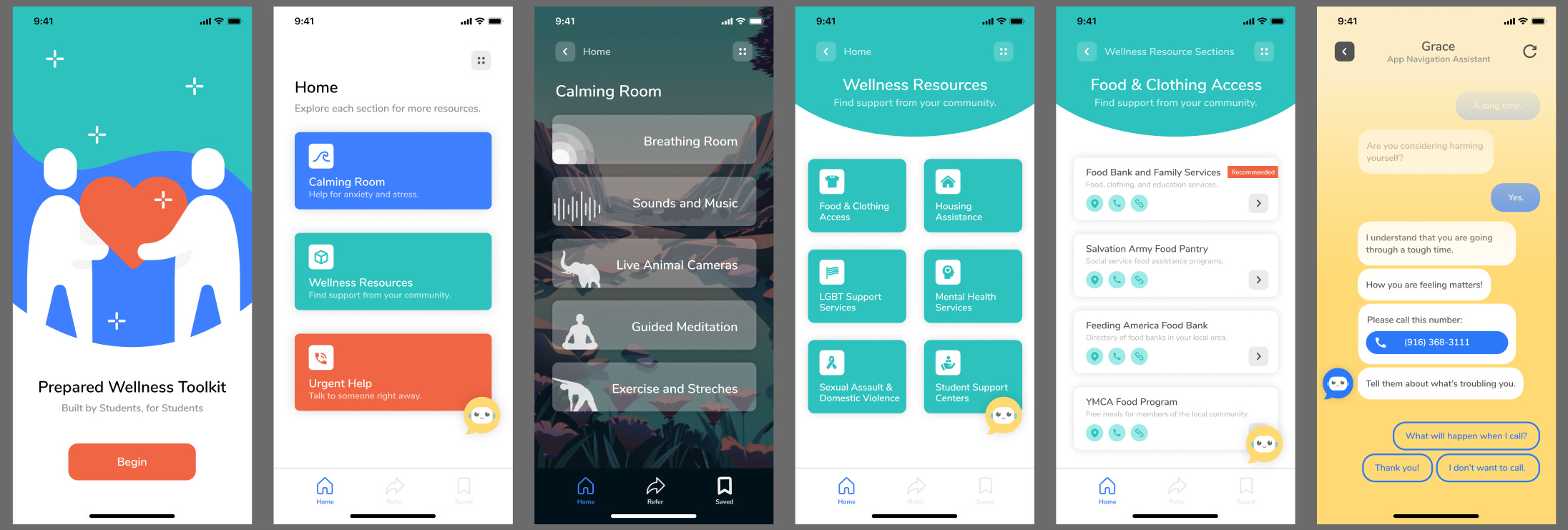
We created a mental health app called GRACE (Giving Resources and Care Everyday) in the hope such a resource might prevent school shootings, connecting students with mental and physical health sources.
These solutions each brought in six figures in revenue but did not scratch our product market fit framework. So we kept on going...
We dug deep into how to connect emergency services with our schools, hoping to get first responders on scene faster with better context than ever.
That question is what sent us into emergency call centers on a research mission (which will be the subject of my next post!)
That insight led us to hackathoning the idea that put our name on the map: our live-video-to-911 software.
What Six Years Taught Us
Six years on, and after joining forces with Axon, the trajectory of our story has taught me a valuable lesson: To land on the one idea that truly takes off, you must persist, be obsessed about the problem you are solving, and keep iterating on ideas, unattached to any given solution.
We were so passionate about our mission to save lives that we were willing to keep pivoting and pulling all-nighters to prove out every idea and give it a fair shot. And I’m incredibly grateful that we were able to work with folks who were willing to hear us out.
I often think back to the three naive students we were at Yale. We probably seemed audacious to some. Overconfident to others. But our unwavering vision was our North Star that always kept us on track.
Looking back, it was our tenacity, and being a little delusional in our own abilities that enabled us to make real change. We just were not afraid to fail.
I recently came across the Winston Churchill quote that truly resonated with our journey ↓
Success consists of going from failure to failure without loss of enthusiasm.