

The day we saved a life
The 911 call that changed our startup...and the future of emergency response.

Three minutes, thirty seconds. That’s all it took.
In that window of time, so many futures were irrevocably altered by one routine 911 call.
An unconscious man was brought back to life, a caller became a hero, a 911 dispatcher shifted the dynamic of emergency response forever, and a company struggling to find momentum was catapulted into a whole new direction.
It was August 2021 — a day when Prepared Live’s streaming technology proved to be a tipping point for us as a company.
Just one month earlier, my co-founders and I had pulled all-nighters to finish the beta version of our new live-video-to-911 software, without knowing if it would be useful in the real world.
Our theory was simple: If we could allow 911 dispatchers to utilize a caller’s phone and turn it into an on-the-scene camera, they would have eyes and ears on the ground, creating a more efficient emergency response.
It felt crazy to us that calltakers were flying blind, limited to audio only. It meant descriptions and details were often unclear from a caller in an emotionally heightened situation.
Yet it struck us that people had been walking around for years with mobile devices capable of live-streaming video…but this capability hadn’t been used by emergency services.
Until that day in August when our product was used for the first time.
We received a Slack notification as a dispatcher in Nevada created an ‘incident’ using our software. Five of us — almost our entire company at the time — jumped on to watch the video feed from our ‘hacker house’ apartment in New Haven¹
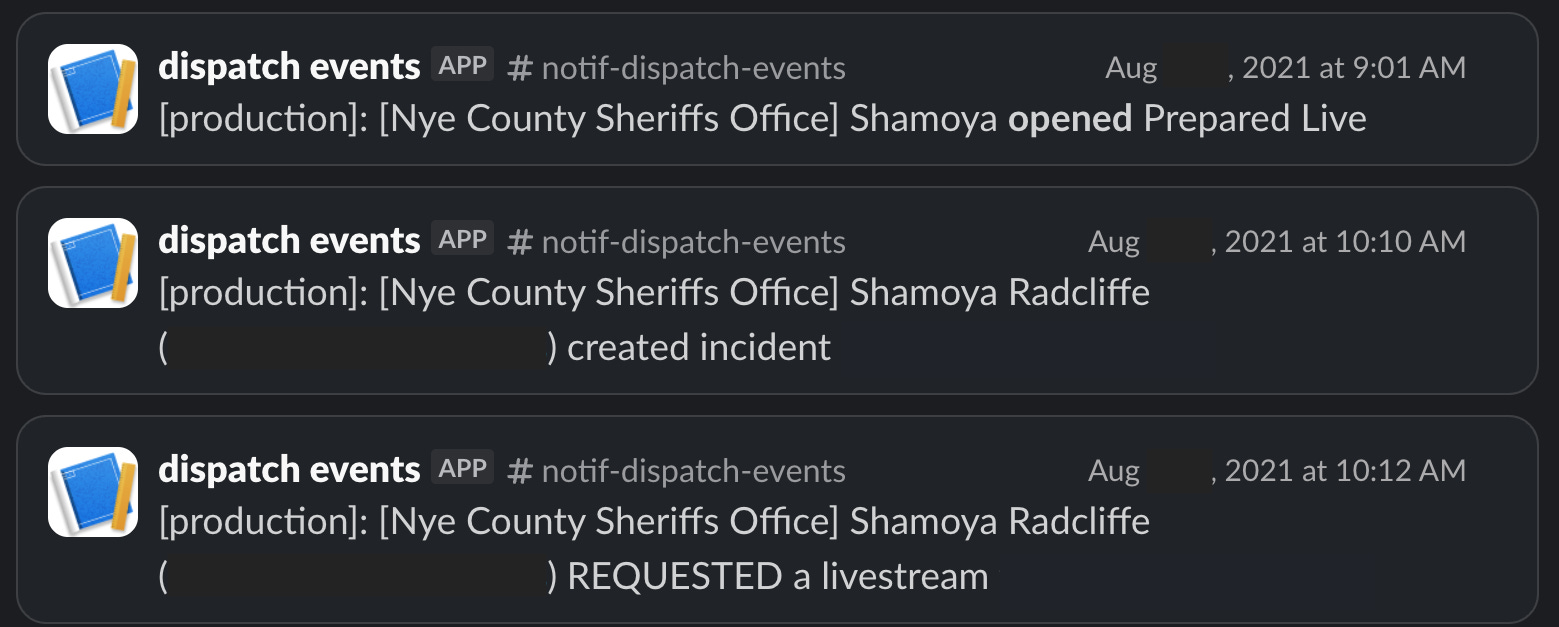
Dispatchers had grown used to relying on hope that a stranger could execute such life-saving advice over the phone. But this time, by using Prepared Live software, Shamoya was going to be ‘transported’ to the scene.
Eyes on the ground
Shamoya sent a video link to be opened on the caller’s phone, meaning she could “go live” and have eyes on the scene via the phone’s camera livestreaming to her screen.
In Nevada, other dispatchers gathered around Shamoya’s bank of screens as my co-founders and I were glued to the same footage in New Haven.
I found myself holding my breath as all efforts were focused on getting a man to breathe again. He had collapsed and was both unconscious and unresponsive.
From the moment we launched Prepared, our guiding mission was to build software that saves lives. And now we were seeing that mission become real.
We watched as the caller held the phone, a bystander carried out CPR, guided by Shamoya and her supervisor — and that’s when she noticed the resuscitation was not being carried out properly.
His hands were too low, but she was able to correct this error not once, but three times — a crucial intervention, made possible by our live video feed.
At that point, an EMS unit arrived … and the feed was cut, Shamoya jumped onto another call, and we were left hanging. What happened? Did the guy survive?
For Prepared, this was a make-or-break moment. For Shamoya and team, this was a routine incident. Typically, they wouldn’t even find out what happened to a patient, but, this time, they asked.
“He made it,” said the EMS unit.
When we heard that news, the five of us in the apartment looked at one another in a state of disbelief. It’s one thing believing in a mission, but, trust me, it’s another thing to actually see someone brought back from the brink of death because of the software you created.
When you consider that out-of-hospital cardiac arrests have an incredible low survival rate — approximately 90% of patients die — that visual guidance was critical.
That’s when one thought hit me: If we had not stayed up all night building that software, would that person be with us today? According to the experts, probably not.
And yet, in the weeks before, we had started to doubt if Prepared’s products even had a viable future.
Overcoming resistance
Our live video capability had been largely dismissed as another burden for already over-tasked dispatchers. In fact, only two centers had agreed to give the software a try: New Haven in Connecticut, and Nye County in Nevada.
The nationwide usage we had anticipated — that we built for — wasn’t materializing. And the pushback was loud and clear:
> “We’ll never use live video. Calltakers sit behind the desk because they don’t want to see the other side of a call.”
> “Our staff already has too many screens without adding another.”
We understood that resistance, too. Dispatchers work in a pressure cooker environment, already multi-tasking without having to adopt and learn a new system. In addition, call centers were dealing with more calls than ever before, using more tools than ever before, while having less staff than ever before.
But we believed passionately in the value of live-video in emergency response, and knew there was a gap in the market.
“Imagine if you the dispatcher could SEE what was going on before responders arrived, and what a difference that immediate assessment could make,” we had told them.
So that one incident in Nevada — those 210 seconds — proved to be a collective “ah-ha” moment. It changed everything. Especially for the dispatchers who started to evangelize among themselves about using the product on more and more calls.
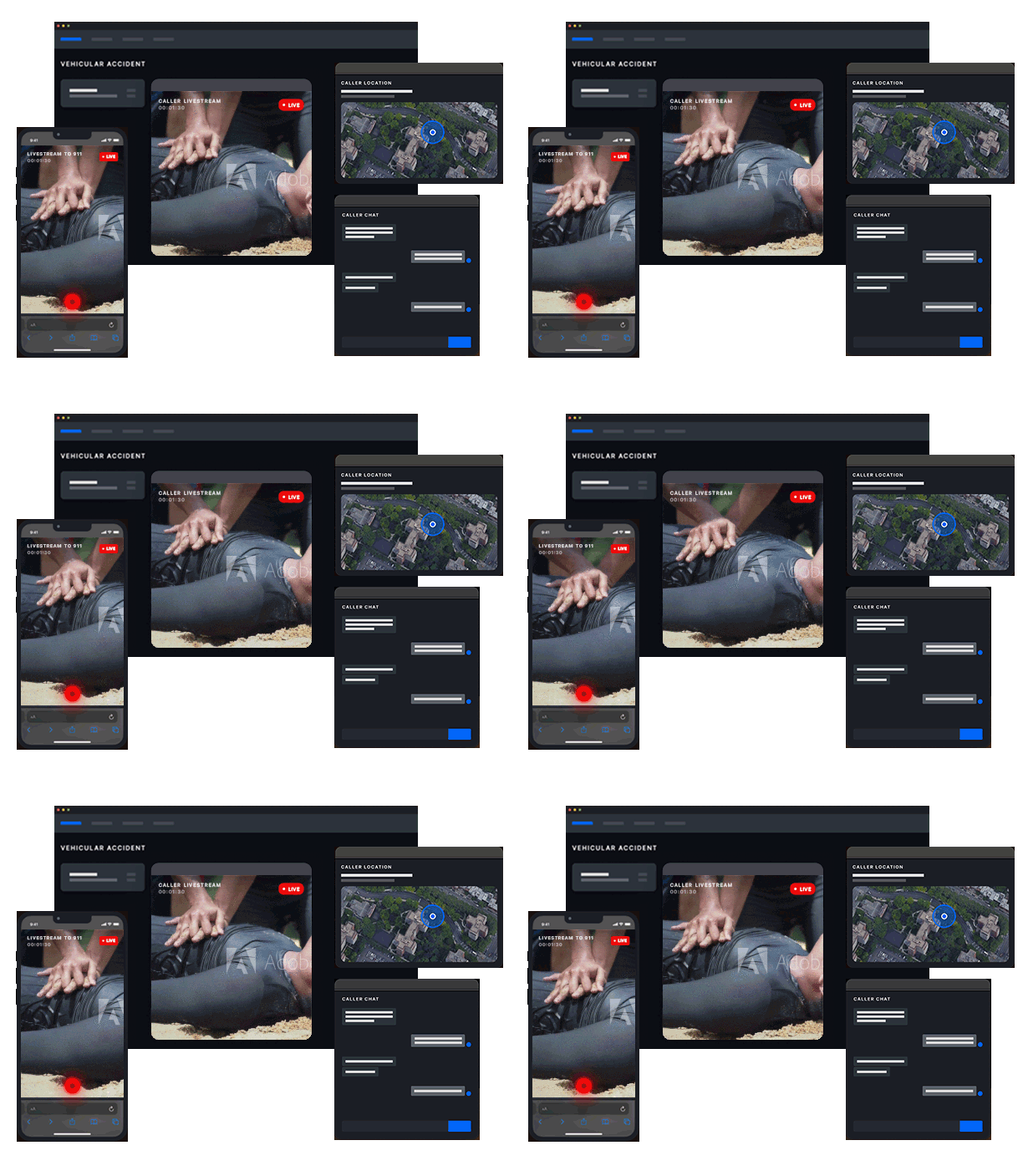
As Shamoya said: “The experience was a mixture of ‘Wow, we’re actually there’ and ‘Wow, what a difference this makes!’ It was amazing.”
From that day, word spread center to center, state to state.
Within the next two months, thirty agencies signed up for the product.
The Turning Point
It proved to be a huge turning point for Prepared. At the time, we had two other products — our reactive panic button app and our proactive mental health app — both designed to mitigate school shootings. But they had never saved a life. So we had a choice to make.
As an early-stage startup, you can only truly focus on one thing, one product. Multi-tasking and a split focus might work in the world of dispatchers but not for an eight-person team.
We reminded ourselves that our goal was to build software that saved lives… and we all had the same thought: Could we repeat this life-saving incident? What would happen if we scaled across the US?
It was a lofty ambition, but there really wasn’t much to think about. Prepared Live had to be our focus. Meaning we had to throw away the last 2.5 years of work in schools, plus a six-figure revenue, to pursue a free product (but that’s a story for another time).
It proved the right decision. Since then, we hear weekly stories featuring Prepared’s live-video-to-911 being used in creative life-saving ways. For example:
During a “house fire” in Knox County, IN, the caller mentioned her “single story” property. But the dispatcher identified, via video, that it was a mobile home and gas tanks were inside. With the caller standing 30ft away, the dispatcher ordered the person to move 100ft away to safety. Moments later, there was an explosion.
In Iowa County, IA, a caller reported “a cut” to his arm from a weed whacker. The dispatcher was able to see the wound and noticed significant blood loss. Seconds later, the caller started to drift in and out of consciousness. A Med-Flight, not a paramedic, was sent up, saving critical minutes…and the man survived.
In Anoka County, MN, a man was injured after being held hostage in a hotel but was able to discreetly live-stream from his cell phone, allowing the dispatcher to guide a SWAT team so they could make a successful rescue and arrest two suspects.
To date, live video has been used in the most critical calls: thousands of fire calls, vehicle related incidents, and medical emergencies. And we’ve helped deliver babies when the ambulance didn’t arrive in time.
Today, we partner with more than 1,000 agencies in 49 states and protect nearly 100 million people.
Prepared is now regarded as an indispensable tool. As Shamoya told us: “If it was taken away now, we’d go back to how things were, which left a lot of questions as we were not able to see what was going on. I’d probably feel helpless in a lot of situations.”
The Future
Had that man’s life in Nevada not been saved, I suspect Prepared would have floundered. We struggled to get our software to be used — live-video included. But the conviction we had in the mission, fueled by witnessing that single incident, made us determined to crack the usage code.
We trusted in what we had built … and that faith paid off. After 12 months of iterating and testing idea after idea to get live video to be used, we cracked the code.
And we learned one valuable lesson: If your product makes sense from a first principles perspective — if it feels like a well-reasoned solution when stripped down to its fundamental purpose — you have to be willing to trust your gut and run through barriers to get it adopted.
Making a real impact often requires seeing the non-obvious answer. Breaking new ground requires an unwavering personal conviction and product confidence.
So know that your vision will be tested. As will your self-belief. But remember: it’s not supposed to be easy.
Be bold, believe in what you’re doing and why you’re doing it… and don’t be afraid to redefine what’s possible. Maybe you’ll save a life along the way.
About Neal Soni: Co-founder at Prepared — specialists in emergency response, driven by a mission to save lives. Launched in 2019. Acquired by Axon in 2025 for $640m. And as VP of Product, Neal writes about his journey, insights, and learnings as one of the architects of that success story.
It’s incredibly exciting and fortunate that we get to hear about the product decisions Prepared made along the way and the positive impact they’ve had on your customers and society as a whole. Please keep writing, this is interesting!
Inspiring, and well-written!